
Expanding academic horizons: POLIS student at national research conference
This blog is written by final year International Relations student Rosie Evans to detail her experience of presenting her dissertation research at the British Conference of Undergraduate Research 2024. It not only demonstrates the excllence of her work, but also underlines the importance of recognising student's as emerging scholars and I recomend this piece to final year students and their supervisors.
Through unwavering faculty support in my final year as an undergraduate International Relations student at the University of Leeds, I was able to undertake my dissertation project into ‘How do the intersections of gender and race inform the depictions of white female Islamic terrorists in the British media? An investigative examination of ‘White Widow’ Samantha Lewthwaite’. This project combined an intersectional theoretical framework, a literature review and qualitative media content analysis to uncover the racial and gendered biases that underpin the representations of white female Islamic terrorists. My research found Samantha Lewthwaite to be a microcosmic display of the macrocosm of British social inequalities, putting forward two overall main arguments: 1) depictions of white female Islamic terrorists in the British media cannot be fully understood without considering the simultaneous impact of gender and race and 2) the racial and gendered issues in British society are reproduced through depictions of white female Islamic terrorists within British media.
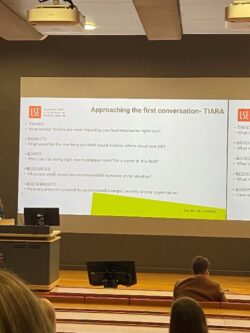
As a result of the completion of this research, I was afforded the opportunity to attend the multidisciplinary British Conference of Undergraduate Research 2024. Held at a different British university annually, this year’s conference took place in the esteemed London School of Economics and Political Science. While many people have a conception of LSE as a university exclusively for economics students, we were reminded while there of the importance of Political Science in their institution, teaching and ethos. We were met with inspiring talks from Professors and Drs at LSE, given a chance to view the creative posters from undergraduate students and were able to attend any of the informative workshops provided. In our digital age where networking is increasingly important, I decided to attend ‘Using Social Media for Efficient Networking Strategies’.

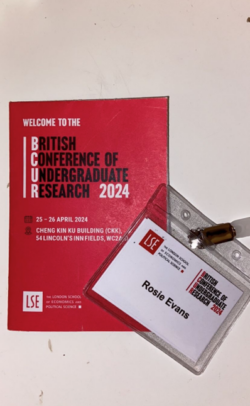
While undoubtedly nervous for my presentation on the days leading up to the conference, the University of Leeds students (who made up a large percentage of the total students attending the conference overall) were supported both financially and professionally by the university, creating a positive and confident atmosphere among us that translated into our demeanours within our oral presentations. We were given resources, presentation preparation workshops and financial aid for transport, accommodation and food. This alleviated many of the barriers students might face in attending a conference in a different part of the country. Further, this conference is open to undergraduate students only, which creates a sense of community and shared support, rendering it less intimidating for those who have perhaps never presented at a conference before. I received a multitude of positive feedback from the audience after my presentation, affirming the conference’s friendly and supportive environment, pushing me to want to continue in the field of research and presenting.


I view attending university as a privilege. The ability to consume and share knowledge is something that is not readily available for all across the globe, thus assuming a role as a researcher carries with it a responsibility to take the opportunities we are given to share our research with others. As undergraduate scholars, we dedicate substantial time and effort towards our various research projects. This academic conference serves as a platform to be formally acknowledged and validated for the efforts we have invested in enhancing academic research and scholarly knowledge. Beyond this, it provides an opportunity to learn from other undergraduate students in different fields than us, as well as make valuable networking connections with peers that might, at a time, serve us in our careers or personal growth in ways we don’t know in this current moment.