
From the Balkans to the Future: A student Journey to the NATO Youth Summit
By Chloé Simpson, 2nd year BA International Relations, School of POLIS
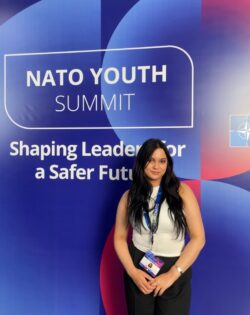
This past weekend, I had the immense privilege of being invited to attend the annual NATO Youth Summit in Budva, Montenegro – an unforgettable experience where I not only represented the United Kingdom and the University of Leeds in a global setting, but also gave me an entirely new perspective on global cooperation, regional complexity, and the power of youth engagement.
A Seat at the Global Table
My journey to Budva began through the NATO Youth Summit Challenge: a competitive international call for young leaders aged 18–35 from NATO Allies and partner countries to share their vision of future leadership. The prompt for this year’s competition asked us: “What does a leader of the future look like? What values, skills, and qualities will be essential to navigate an evolving global landscape, and what concrete actions should they take to build a safer world?”. I chose to create a policy recommendation infographic, which allowed me to clearly communicate complex, interrelated ideas in a concise, accessible format – a skill which I believe future leaders must possess. Selected from a competitive application pool of over 1,500 applicants, I joined more than 400 young leaders from across the globe in workshops, panels, and cultural exchanges organised by NATO and the Atlantic Council of Montenegro.
From the moment I arrived, the energy was electric. We weren’t just discussing policy, we were also forming friendships, challenging assumptions, and engaging in dialogues that felt urgent and hopeful all at once. Among the highlights of the summit was the chance to engage in discussions with high-level policymakers, researchers, experts, and world leaders – people whose work I had only studied from a distance in lecture theatres and textbooks. Notable attendees included: Jakov Milatović, President of Montenegro; Agnieszka Homańska, Head of the Minister’s Cabinet in the Polish Ministry of Foreign Affairs; and Blerina Abrazhda, Albanian Deputy Minister of Defence
To hear directly from Radmila Shekerinska, NATO Deputy Secretary General, was a moment of real clarity for me. She told us, “when security is threatened, nothing else matters”. This quote grounded every conversation that followed. It gave weight to our discussions on hybrid threats, defence innovation, and peacebuilding in Ukraine. More than that, it reinforced the critical role our generation will play in shaping a safer, more resilient future. In that room, surrounded by peers from across continents and perspectives, it struck me how foundational security is – not just in a military sense, but as the bedrock for education, development, freedom, and even imagination. It’s something we often take for granted until it’s gone. As an International Relations student, I’ve spent countless hours dissecting security theories in lectures, seminars, and essays. However, hearing the message from someone who has lived through real-world conflicts made those concepts feel urgent and tangible. Being able to study at university is a privilege I deeply recognise, especially when considering the daily struggles people across the world endure.
Connecting personally with young people from Ukraine offered first-hand insight into the experience of losing security, further emphasising how important it is to protect and rebuild the foundations that allow communities to thrive. Their stories of displacement, resilience, and hope brought the abstract theories of my degree into sharp focus, demonstrating that behind every policy debate are real people whose lives are directly shaped by the decisions made in global institutions like NATO. One of the most powerful moments of the summit was hearing Victoria Vdovychenko, Joint Programme Leader of the Future of Ukraine Programme, speak on rebuilding her country. Her words: “There is no future tomorrow, if we do not talk about it today…the days of mourning are sad days, but we look to the future and it is bright” - encapsulated the spirit of resilience I not only saw through the Ukrainians I met, but that ran throughout the summit.
The power of dialogue as an act of resistance and rebuilding, mirrored the very essence of the human security perspective I study at Leeds. By addressing not just military threats, but also the social and economic scars of conflict, her statement offered a profound reminder: securing peace is not only about preventing war, but about ensuring a liveable, hopeful future for those most affected by it.
Outside of these discussions, the summit offered an incredible array of professional development opportunities. From sessions on career pathways and workshops on crafting successful applications, to open conversations with NATO staff about internships and early-career positions, I walked away with a much clearer vision of the steps I could take toward a future in diplomacy. I learned that internships at NATO are open to students aged 21+, and that applications are reviewed holistically - with real emphasis on motivation, values, and soft skills. The “Next-Generation Leadership” panel encouraged us to translate frustration into action, and hearing from young professionals already within NATO, many of whom had applied multiple times before being accepted, reminded me that persistence, preparation, and passion are key. The Model NATO exercise was another unique feature of the summit, offering participants the chance to simulate diplomatic negotiation and crisis response. Although I didn’t take part this year, seeing my peers embody the roles of diplomats and defence advisors reinforced how valuable hands-on learning and collaborative problem-solving are in international policymaking. 

From Cliff-Jumping to Conflict Legacies
Yet the most moving moment of the trip came not during a panel, but the day after the summit ended. A small group of us who had met at the summit befriended Jana, a 19-year-old from Budva, who invited us on an impromptu road trip along the Montenegrin coast. She took us to hidden local spots and traditional restaurants within her hometown. I experienced the hospitality I had seen from the Montenegrin people time and time again on another level: Jana invited us into her family home, fed us dates and opened up about the enduring impact of the Yugoslav conflict on her family and wider community. As the daughter of a Kosovan mother and Serbian father, Jana’s experience in the Balkans was a point of view I might never have heard had it not been for this trip.
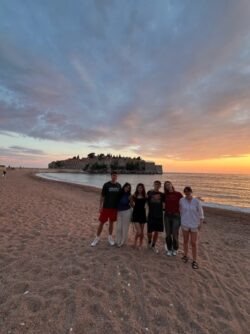
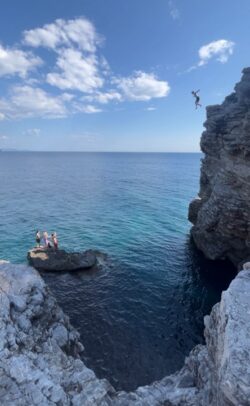
We ended up cliff-jumping into the Adriatic and swimming in a secluded cove where Ukrainian and Russian teenagers played together in the sea – young people who had all relocated to Montenegro to escape the war in Ukraine. Watching them laugh, splash, and simply be kids together reminded me that human connection doesn’t always follow the cold boundaries shaped by the political landscape. It was one of the most poignant moments I’ve ever experienced. As the sun set over the beach at Sveti Stefan, lying beside new friends from across the world, I realised this summit had offered far more than professional development. It had given me a living lesson in resilience, peace, and shared humanity.

Looking ahead
The NATO Youth Summit is so much more than a conference. It has inspired me to pursue a future in international diplomacy and policymaking, focusing on tangible change. I learned about professional pathways within NATO, including internships, mentorships, and entry-level roles. What stuck with me most was the advice from NATO’s Ioana Tudorie: “Tunnel frustration into action—create the change you want to see”. To any aspiring changemaker within POLIS: this is your invitation. Start listening. Ask the right questions. And when an opportunity like this comes along – take the leap.
I would like to thank Emily Gee, Louise Pears, and Madeleine Le Bourdon for their continued support and for giving me a platform to share my experience!